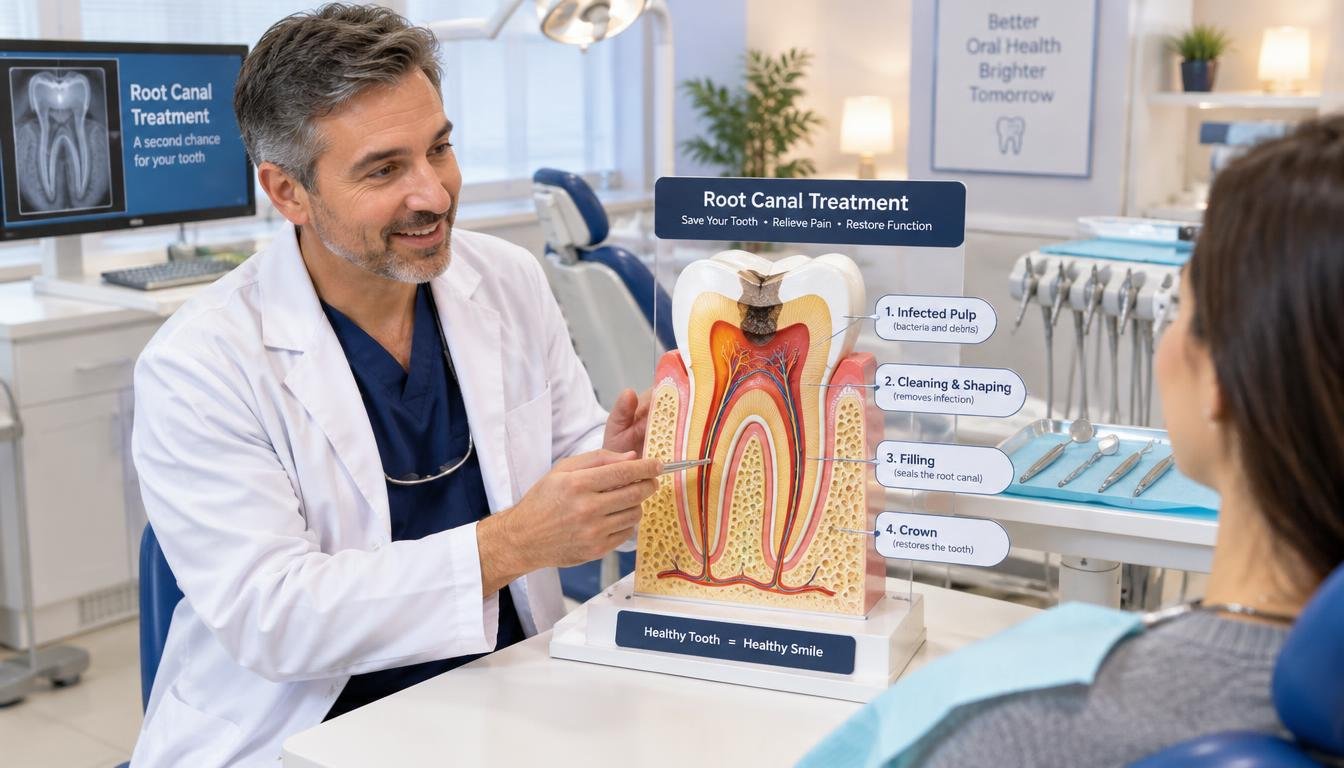
A root canal removes infected or inflamed tissue from inside a tooth so the dentist can clean and seal it. The goal is to stop infection and preserve your natural tooth. If you are facing tooth pain or a possible infection, knowing what comes next can make the appointment feel less uncertain.
The treatment may involve a dentist or an endodontist, a specialist in problems inside teeth. You will learn how to prepare, how long an appointment may take, and what recovery can feel like. Your own dentist can explain how your health and the tooth’s condition affect your care.
Key Takeaways
- Root canals remove infected or inflamed pulp and seal the canals.
- Local anesthesia should prevent sharp pain during treatment.
- Most cases take one or two visits, with molars taking longer.
- Mild soreness can last several days and should improve.
- A permanent crown or filling protects the treated tooth.
The next useful step is to understand which symptoms and tooth problems lead a dentist to recommend treatment.
What Does a Root Canal Treat?
A root canal may be recommended when bacteria reach the pulp, the soft tissue at the center of the tooth. The pulp contains nerves, blood vessels and connective tissue. Treatment can stop infection while helping you keep the natural tooth.
Bacteria may reach the pulp through deep decay, a failed filling, a crack or an injury. More than 15 million root canals are performed each year. Some teeth show a problem on an X-ray before you notice clear symptoms.
A root canal may treat pulp infection and help preserve the natural tooth.
Brief hot or cold sensitivity can fade quickly. Lingering sensitivity, especially after the heat or cold is gone, may signal a deeper problem. Still, symptoms alone cannot confirm that you need a root canal.
A dentist checks your symptoms, examines the tooth and may use X-rays. A tooth may need treatment even when pain is mild or absent, while a sore tooth may have another cause.
Possible signs include:
- Pain when chewing or biting
- Hot or cold sensitivity that lingers
- Tender or swollen gums near the tooth
- A small gum pimple or boil
- Tooth discoloration
These signs do not prove that the pulp is infected. Your dentist assesses the tooth and gums before recommending care. A prompt check can help prevent decay or infection from causing more damage.
Persistent tooth pain or a gum pimple deserves a dental assessment rather than a wait-and-see diagnosis at home.
Root Canal Treatment: Procedure, Recovery, and What to Expect
The appointment begins by numbing the area and keeping the tooth isolated from saliva. A dentist or endodontist uses local anesthesia and a dental dam, a small sheet that shields the tooth. Local anesthesia should prevent sharp pain, though you may feel pressure or vibration.
Tell the provider if you feel sharp pain. More anesthetic can be given if needed. If dental care makes you anxious, share that concern before treatment and agree on a hand signal for a pause.
How the dentist numbs and isolates the tooth
After the area feels numb, the dentist places the dam around the tooth. It helps keep saliva away and gives the provider a clear working area. You can still breathe and speak, though the dam may feel unusual at first.
Evidence on medication for anxiety during root canal treatment is limited. A review of four studies found low-quality evidence and could not determine whether anxiety drugs change pain during treatment. Benzodiazepines did not reduce pain or improve how well anesthesia worked.
How infected pulp is removed and the canals are cleaned
The dentist makes a small opening through the tooth’s crown, the part above the gums. Through this opening, the provider removes infected or inflamed pulp from the canals inside the roots.
The roots stay in the tooth. The dentist cleans and shapes the canals, then disinfects them to reduce bacteria. A home rinse cannot reach or disinfect the inside of the tooth.
Nitrous oxide, sometimes called laughing gas, reduced pain perception in evidence with low overall quality. It does not guarantee a pain-free visit. Ask which comfort options fit your health and treatment.
How the canals are filled and sealed
Once the canals are clean and dry, the dentist fills them with gutta-percha, a rubber-like filling material. The provider seals the opening with a temporary filling. A permanent crown or filling may follow at another visit.
The crown, when needed, restores the treated tooth after canal treatment. It does not replace the roots. The number of canals and the tooth’s condition can shape the dentist’s plan.
Tell the provider immediately if you feel sharp pain rather than trying to tolerate it silently.
How Long Does the Procedure and Full Treatment Take?
Plan for about 60-90 minutes for a straightforward appointment, with molar treatment often taking longer. Most root canals take one or two office visits. The total time depends on the tooth and the treatment needed.
A visit includes anesthesia, cleaning and shaping the canals, and a temporary filling. A crown appointment, if you need one, is scheduled separately. These estimates describe chair time, not the full span between appointments.
Chair time by tooth type
Front teeth often have fewer canals than molars, which can make them quicker to treat. The table gives typical chair-time estimates, not a guaranteed appointment length.
| Tooth type | Typical chair time | Common visit pattern |
|---|---|---|
| Incisors and canines | 45-60 minutes | Often one visit |
| Premolars | 60-90 minutes | Often one visit |
| First and second molars | 90 minutes to two hours | May need more than one visit |
Many front teeth and premolars are completed in one visit under 90 minutes. First and second molars can take 90 minutes to two hours. Tooth complexity and infection can affect the plan and the time needed.
How visits and the crown fit into the timeline
As of October 2026, most treatments take one or two appointments, with 60-90 minutes of chair time per visit. A second visit may be needed to finish treatment or place a restoration.
The crown is a separate appointment when one is needed. The dentist may first place a temporary filling, then schedule the permanent crown or filling. Ask when to book the next visit and how to protect the tooth until then.
Ask whether your appointment includes only the canal treatment or a separate restoration visit.
What Is Normal During Recovery, and How Long Does Healing Take?
Mild tenderness for a few days is common, and it should trend toward improvement rather than intensify. Many people feel mostly back to normal within 48 hours. Most recovery takes less than a week.
The tooth and nearby area may feel tender or sensitive for several days. Pressure tenderness often feels strongest 24-48 hours after treatment, then eases. That change matters more than whether the tooth feels exactly as it did before the appointment.
Some people have only mild soreness for one to three days. Others notice tenderness for several days, even as daily routines become easier. These common timelines describe the soft tissues around the tooth, not a fixed date for deeper healing.
Many patients can return to work or usual activities the next day if they feel well. Follow any instructions that came with sedation, since they may affect driving or other activities. Your own comfort also matters.
A treated tooth can feel different from nearby teeth for a time. That feeling should gradually settle, rather than become sharper or spread. If the trend changes, contact your dentist for advice.
Soft tissue soreness and deeper healing do not follow the same clock. Your dentist can check the tooth and surrounding area if tenderness does not keep easing.
Compare each day’s symptoms with the direction of travel, not just with how the tooth felt immediately after treatment.
What Should You Eat and Avoid After Treatment?
Keep food soft and wait until you can feel your mouth normally before eating. Numb lips and cheeks can make it easy to bite your tongue or cheek. Wait until the anesthesia has fully worn off before eating.
Numbness often fades over four to six hours. After lower-jaw treatment, lip or chin numbness can last up to eight hours. Water at a cool or room temperature is a practical first drink.
What to eat and drink while numbness wears off
Choose foods that need little chewing during the first few days. Soft options include:
- Yogurt
- Eggs
- Mashed potatoes
- Well-cooked pasta
- Smoothies
Avoid very hot coffee for 24-48 hours. Once tenderness settles, choose warm coffee rather than a scalding-hot drink. Wait until numbness wears off before drinking anything that could burn your mouth.
Avoid alcohol for at least 24-48 hours, especially if you take prescribed antibiotics or pain relievers. Ask your dentist or pharmacist about possible interactions with your medicines.
Protect the temporary restoration and keep the area clean
Chew on the opposite side while a temporary filling is in place. Hard, crunchy or sticky foods can damage it or pull it loose. Continue brushing and flossing gently as usual, including around the treated tooth.
Avoid smoking during healing. If you also receive a permanent crown, do not chew while numb. Follow your dentist’s directions for the restored tooth instead of assuming temporary-filling limits still apply.
Until the permanent restoration is in place, avoid biting directly into hard or sticky foods with the treated tooth.
How Can You Manage Pain After a Root Canal?
A treated tooth can be mildly sore even after the infected pulp has been removed. Tender tissue around the tooth can cause pressure or sensitivity. Mild discomfort does not automatically mean the procedure failed.
Before treatment, pain may come from the infected or inflamed pulp. Afterward, the tissues near the root can remain tender. Some people notice discomfort when biting, even as the original tooth pain begins to ease.
What soreness is expected
A tooth may remain painful after treatment because the tissues around it are sore from the procedure. That tenderness should not be confused with the earlier pain from the pulp. Worsening pain or severe pain needs dental advice.
Some patients feel pressure or sensitivity when chewing. The dentist can check the treated tooth if the bite feels wrong or pain grows stronger. Do not assume that every ache means a new infection.
Medication and safe pain relief
For adults, a common ibuprofen example is 400-600 mg every six hours with food. A common acetaminophen example is 500-1,000 mg every six hours. Ask a clinician to confirm your dose and daily limit.
Depending on your health and other medicines, these examples may not be right for you. Acetaminophen’s stated daily limit ranges from 3,000-4,000 mg. Check all medicine labels to avoid taking acetaminophen from more than one product.
One described schedule alternates ibuprofen and acetaminophen every three hours. A clinician should confirm that schedule before you use it. Do not treat these examples as a personal prescription.
Antibiotics are not routine treatment for pain alone or routine prevention after treatment in healthy patients. They may be needed for other clinical reasons, so follow the plan your dentist gives you.
Check the medication label and your clinician’s instructions before combining or alternating pain relievers.
When Should You Call the Dentist, and What Happens If Pain Returns?
Call the dentist if pain is getting worse after day three, rather than settling. Pain that lasts beyond a week also needs a check. Fever above 100.4°F or significant swelling calls for prompt dental advice.
Contact your dentist or endodontist if you notice any of these problems:
- Worsening or severe pain, including pain that does not ease with over-the-counter medicine
- Swelling or a fever above 100.4°F
- A bite that feels uneven when your teeth meet
- A lost temporary filling or crown
- An allergic medication reaction or return of the original symptoms
Symptoms that need a prompt call
Severe pain or pressure lasting more than a few days deserves attention. So does visible swelling, a medication reaction, or a tooth that feels too high when you bite. Tell the office when each symptom began and whether it is changing.
Do not wait for a routine checkup if the original symptoms return. Fever, swelling and pain can have different causes, so a dentist needs to examine the tooth and your health history.
Why a treated tooth can become painful later
A treated tooth may become painful or diseased months or years later. An untreated or undetected canal, new decay, a loose or broken restoration, delayed restoration or a fracture can be involved.
The symptoms alone cannot show which problem is present. A dentist or endodontist may examine the tooth and take X-rays. Retreatment may be considered if the tooth heals poorly or becomes painful or diseased later.
Report changes in the treated tooth even if the original procedure seemed successful. A prompt exam can help identify the cause and protect the tooth from further damage.
A lost temporary filling or crown warrants a prompt call so the tooth can be protected.
How Long Can a Root-Treated Tooth Last, and Does It Need a Crown?
The next step after canal treatment is to restore the opening, and that may mean a filling or a crown. A crown is not automatically required for every treated tooth. The choice depends on the tooth and how much healthy structure remains.
Why a crown or filling may follow treatment
After a root canal, the next procedure may be a filling, crown preparation or crown placement. A filling restores a tooth when enough structure remains. A crown covers and protects more of the tooth when its shape or strength calls for it.
Your dentist recommends a restoration based on the tooth’s condition. A crown, also called a cap, is not needed in every case. The treated tooth can still develop decay, gum disease or sensitivity, so regular care remains important.
What the survival figures mean
A study of 71,283 treated permanent teeth in 99 U.S. general dentistry practices found a median survival time of 11.1 years. Twenty-six percent lasted beyond 20 years. A meta-analysis found an 86%-93% pooled survival chance at eight to ten years.
Study medians describe groups of teeth, not a promised lifespan for your tooth.
In that study, teeth with a filling soon after treatment and then a crown had a median survival time of 20.1 years. The figures show associations, not proof that every patient will have the same outcome.
| Restoration received | Median survival time |
|---|---|
| Filling followed soon by crown | 20.1 years |
| Crown only | 11.4 years |
| Filling only | 11.2 years |
| Neither restoration | 6.5 years |
The study’s median survival figures were 11.4 years with a crown only, 11.2 years with a filling only and 6.5 years with neither. Crown placement after treatment was associated with 5.3 more years of median survival time.
Keep the recommended permanent restoration appointment, since a treated tooth still needs protection from decay and fracture.
Conclusion
A root canal is intended to remove infection while keeping the natural tooth in place. Timely care can help protect the tooth, gums and nearby bone. Recovery should generally improve, not worsen, as the days pass.
If symptoms persist, call a dentist or endodontist to assess the tooth. If treatment is complete, confirm when to get the permanent crown or filling. That appointment helps protect the treated tooth from damage.
If pain or swelling is not improving, contact your dentist or endodontist for an evaluation.